I am Oscar Emilio Pérez Martínez, a Mexican mobile engineer. For more than ten years, I have built products across Android, iOS, and the services that support them—including Sismos México, Sofie, and SOSMex.
Building for impact shaped how I build
From early in my career, I have been drawn to software that helps people with practical, real-world problems. Sismos México and SOSFem are two expressions of that path: different products, but both created around the idea that technology should be useful when people need clarity, support, or a way to act.
That journey has shaped more than my technical skills. It has taught me to begin with a human need, take the responsibility of safety-related software seriously, and ask whether a product creates value beyond the screen. Ready Together continues that same direction: use what I have learned to build something that can genuinely help people prepare and coordinate together.
What one million downloads taught me—and what they did not
Sismos México has surpassed one million downloads on Google Play. Reaching that milestone matters to me because it shows that clear, useful earthquake information can become part of how people stay informed and prepare.
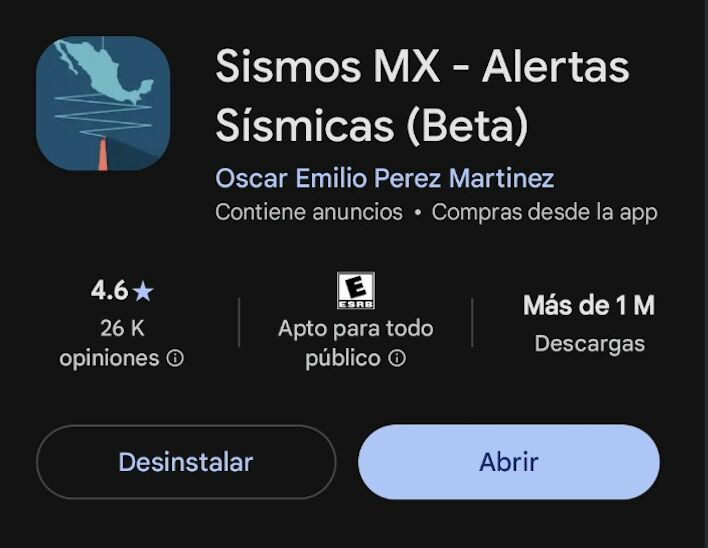
That reach taught me that people value timely, understandable earthquake information. It did not prove that a household knows its meeting point, has assigned critical responsibilities, or can coordinate a shared response. Information and preparedness are related, but they are not the same product problem.
Venezuela exposed the limits of a Mexico-first product
When earthquakes struck Venezuela during 2026, I noticed a wave of people there downloading Sismos México. Their interest mattered, but it also exposed a limitation: the app had been designed around Mexican sources and needs. They were looking for local earthquake context and preparation support that it had not been built to provide.
That experience made the gap more urgent. Helping people across different institutions, infrastructure, language, and connectivity cannot mean importing one country’s product or protocol into another. It requires listening to what people actually need and building local context into the product from the beginning.
Peru made the international need concrete
The magnitude 5.4 earthquake near Chupaca, Junín, on July 18, 2026, gave that motivation even more weight. The Instituto Geofísico del Perú reported that it was a shallow event associated with the reactivation of the Altos del Mantaro fault. For me, the lesson was not to turn another real earthquake into marketing. It was to stop treating international relevance as an abstract future idea.
It led me to prioritize Peru as a concrete product decision. Ready Together now has a bounded IGP/CENSIS source profile for reviewed Peruvian areas, merged but still disabled by default and not publicly activated. The broader principle is more important than the integration itself: international support should be earned one country at a time, using local sources and reviewed context rather than stretching a Mexico-first experience across borders.
Colombia clarified the product boundary
On August 10, 2026, the Servicio Geológico Colombiano reported a magnitude 7.4 earthquake near San José del Palmar, Chocó. The official facts were available and attributable. That is valuable—but reproducing a national catalog is not the product I want to build.
The product question begins after the report: why does this event matter to the people and broad areas a private circle chose, who has responded, and what responsibility is still unclear? Colombia helped turn that boundary into a concrete, testable engineering slice.
The missing tool is coordination
Authorities publish guidance. Earthquake apps explain what happened. Messaging apps help people communicate. A written plan records an intention. A household can combine all of them with a timer and a checklist, but the coordination burden remains with one person.
Ready Together is exploring the missing layer: bring the relevant people into one private practice, give each person an explicit responsibility, begin together, retain reviewed instructions when connectivity degrades, and reveal one factual gap afterward.
Why Ready Together starts with a circle
Ready Together explores a private-circle model. A circle chooses broad areas that matter, keeps responsibilities visible, and can practice a shared sequence before a real event. When reported earthquake information is relevant to those selected areas, the product can provide context and open a limited check-in. It is not early warning and it does not replace official guidance or emergency services.
The product also treats drills as product interactions, not as proof of safety. A shared report can record what the room confirmed and identify one thing to improve. It cannot certify that anyone is safe or that a household is prepared.
What exists today
Ready Together is available for Android and iPhone through Google Play and the App Store. Moni and I completed functional testing on both phones before and during launch, and people are now using the production releases. That proves a real two-platform release; it does not prove that every device, network, or private journey has been validated.
Separate backend infrastructure exposes the reviewed bounded earthquake feed plus authenticated private QA routes validated with synthetic data. That backend evidence should not be mistaken for the complete Ready Together mobile journey being released, validated on physical devices, or approved for real participant data.
Why I am writing before launch
Building in public is useful only if it makes uncertainty visible. The goal is not to narrate every commit or turn architecture into marketing. It is to show the decision, the evidence, the limitation, and the next question without presenting unfinished work as a finished product.
My experience explains why I am investigating this problem. It is not evidence that Ready Together works. The next meaningful evidence must come from reproducible product behavior and, later, carefully documented physical testing—not from a founder story.
After reading preparedness guidance, what is the one responsibility your household would still need to clarify before practicing together?
Please avoid sharing names, exact locations, or details from an active emergency.
Public context
- Current Sismos México listing on Google Play
- SOSFem official website
- HUAWEI AppsUP 2020 public announcement
- Instituto Geofísico del Perú report on the July 18 Chupaca earthquake
- Servicio Geológico Colombiano update on the August 10 event
Product implementation claims above are traced to a merged-repository evidence package. This website edition was approved by the project owner; publication elsewhere requires separate approval.